
text and photography by Fred Delcomyn
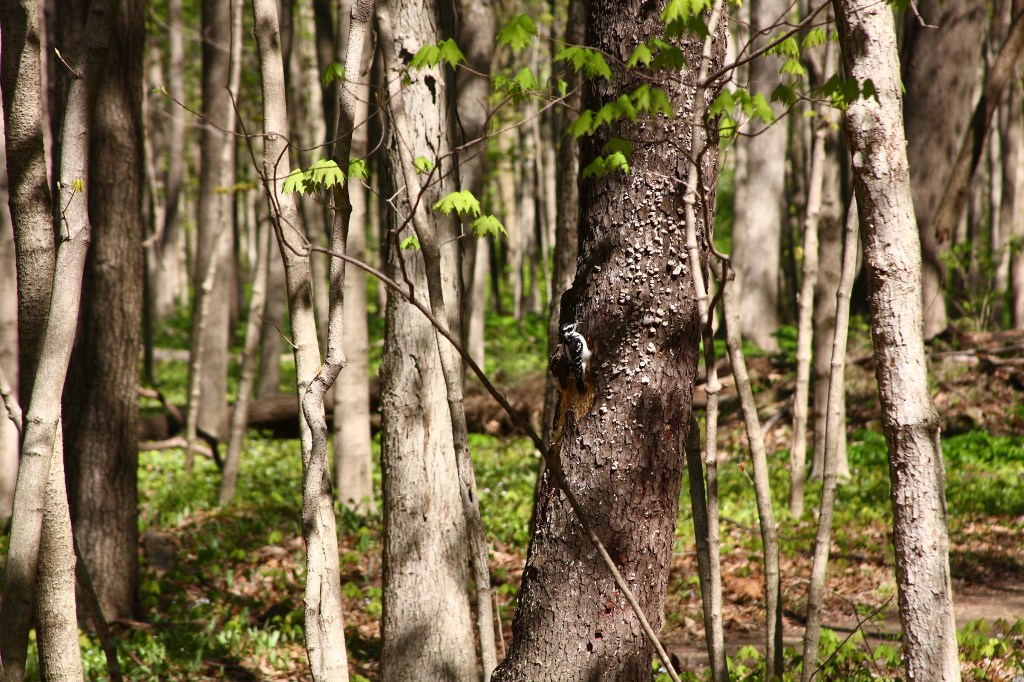
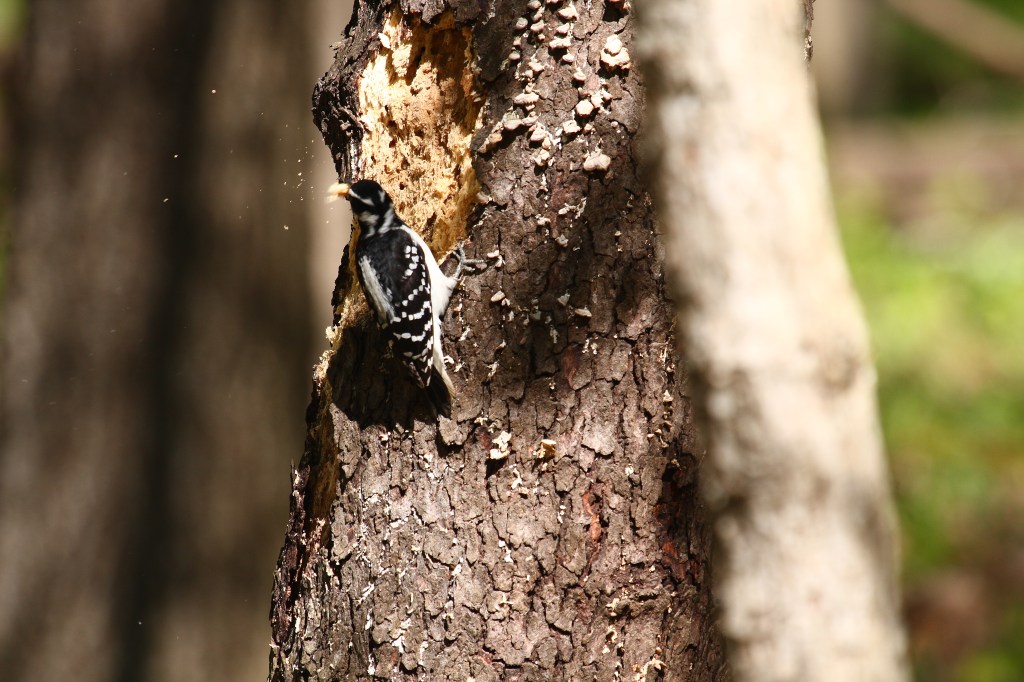
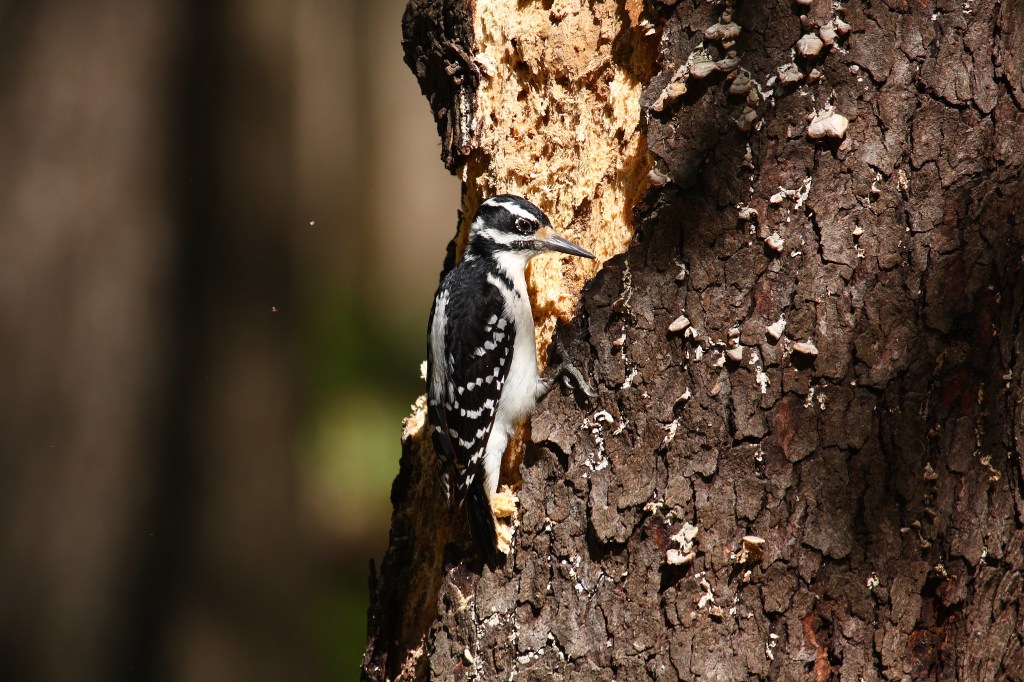
I heard it before I saw it. The rat-a-tat-tat of a woodpecker drilling into a tree was hard to miss. Moving forward slowly that April morning, I finally spotted the source of the sound. A female hairy woodpecker (photo 1), its distinctive black and white stripped body unmistakable, was industriously working on a dead tree. But this was no ordinary dainty pecking. This bird was working so hard on the tree that little bits of wood flew off in all directions with every strike of her bill, the soft wood of the rotting tree being no match for the determined bird (photo 2). Although she was intent on her quest to find the insect grubs she was looking for, she would pause to rest every few seconds, as if posing prettily for my camera (photo 3).
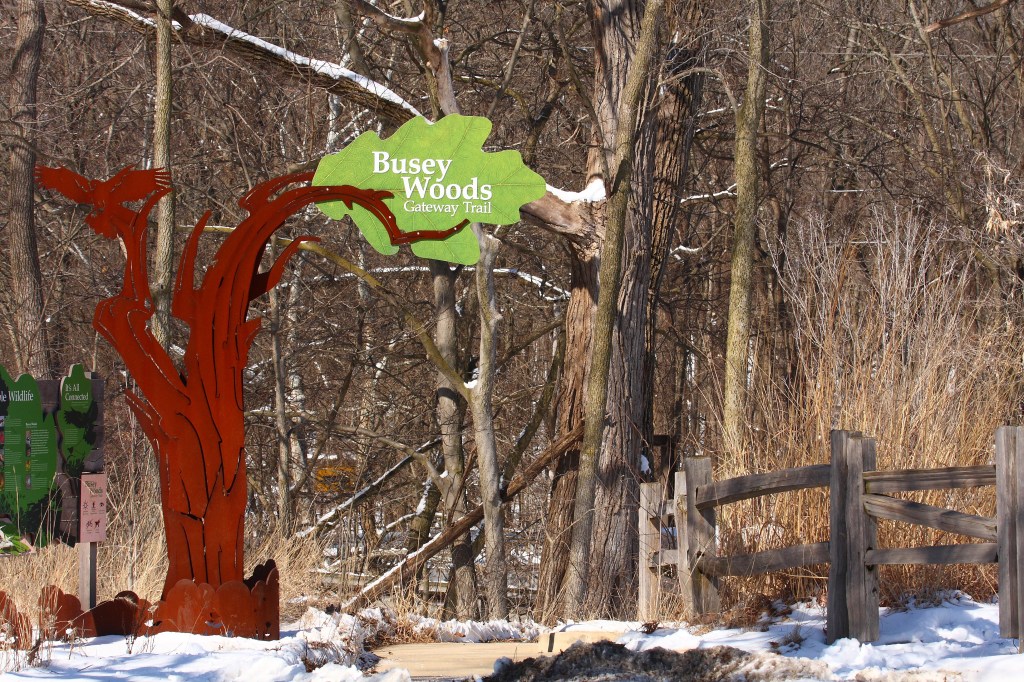
The site of this encounter was the 59 acre Busey Woods (photo 4), an oasis of nature, and a hidden gem, in Urbana owned and maintained by the Urbana Park District in the state of Illinois, USA.
Many long-time residents of Urbana know about Busey Woods, but most people only think of visiting when the weather is nice. Busey Woods, however, is easily accessible and will richly reward those who brave the elements to visit, even in winter. About two miles of hiking trails and a third of a mile of boardwalk invite visitors to explore. The boardwalk has benches in places along the side so visitors can sit and rest while taking in the views (photo 5). Casual footwear will suffice if you stay on the boardwalk, but shoes designed for hiking will serve you better if you go onto the trails.
Busey Woods is not just for warm months. Since it is winter as I write this, let’s consider that season. Winter can be a miserable time of year. It gets dark early. It’s cold. It’s often dank and dreary. These factors tend to keep people indoors. After all, who wants to walk outdoors on an overcast day in sub-freezing temperatures and with a bitter wind blowing?
Busey Woods offers an alternative to indoor activities during the seemingly lifeless months of winter. Even on the bleakest of days, a walk in the woods can uplift your spirits. The Japanese recognize this with their concept of forest bathing. Their phrase for this, shinrin-yoku, can be translated as a visit to a forest for relaxation and health purposes. Chinese culture has a similar concept, forest therapy, which has a greater emphasis on the healing aspects of being in a natural area.
A walk in Busey Woods even in the cold can be interesting as well as invigorating. Before European settlement, Busey Woods was part of the large, wooded area north of Urbana known as the Big Grove. This was an area in which mainly oak and hickory trees grew, supported by nearby streams. The Saline Branch of the Salt Fork of the Vermilion River once ran through this area. Visitors cross over the rerouted Saline Branch via a footbridge when first entering Busey Woods.
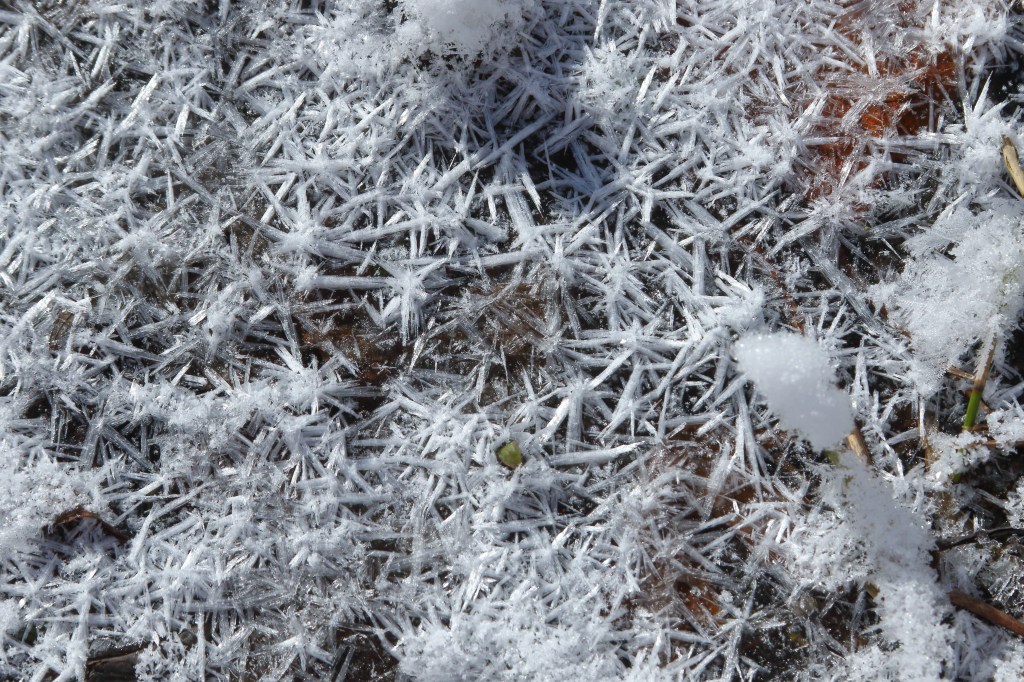
One of the best times to visit Busey Woods is after a snowfall. Even if you just stick to the boardwalk, you can see the wonderful scenery produced by the snow. If you venture off the boardwalk onto the trails (photo 6) you may stumble across small ponds, the result of human activity. In 1909-1910, the Saline Branch was straightened and dredged deeper so it could serve as a drainage ditch to reduce flooding in north Urbana, which was being developed at the time. The meanders of the old river bed were left as they were. In places along this river bed, water pools to form ponds. These ponds usually retain enough water in winter to form intricate and fantastical ice crystals on the surface (photo 7).
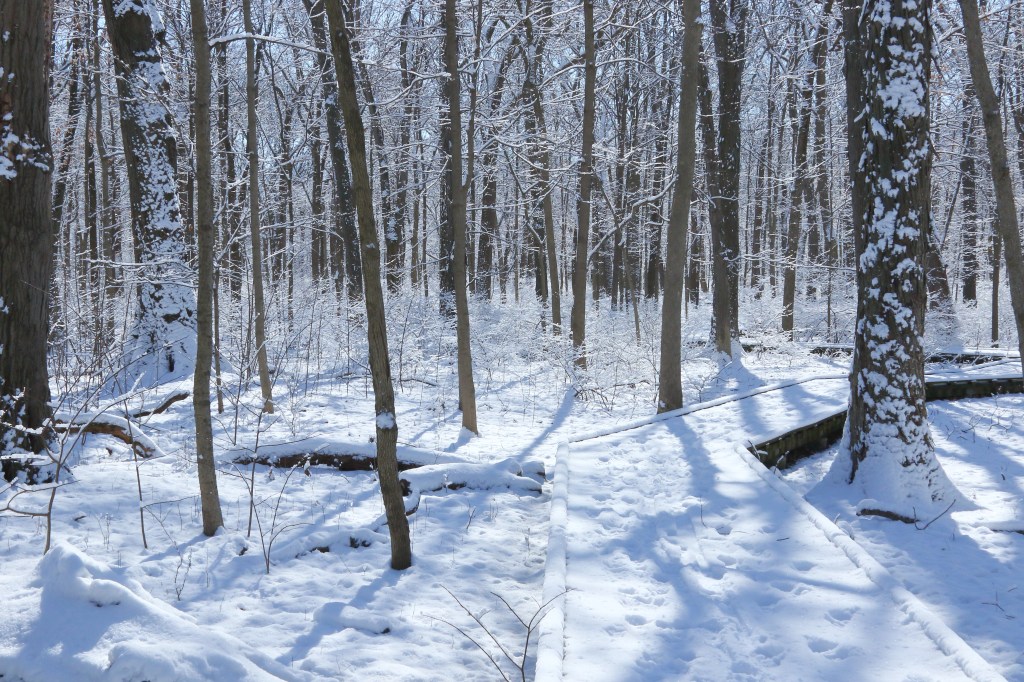
Looking up can bring its own rewards. After a snowfall, snow may cling to the branches of trees and shrubs. This often produces a surreal effect (photo 8). The woods seem to be a different place when snow covers everything.

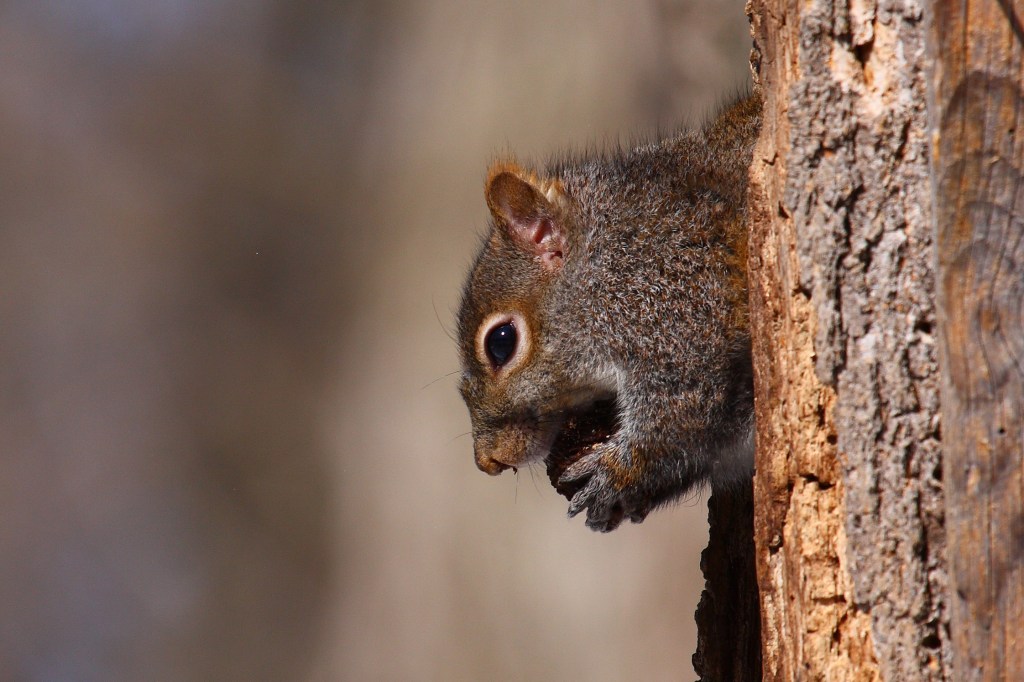
Another advantage of visiting Busey Woods in the winter is that it is often easier to see wildlife when there are no leaves to obscure views. The trees in Busey Woods are mostly oaks and hickories, so there is plenty of food in the form of acorns and other nuts for squirrels to eat. It’s unusual for me to walk in the woods without seeing at least one of these frisky animals (photo 9). Winter also makes it easier to see birds. This is not just because of the lack of leaves, but also because colorful birds tend to stand out against a snowy background (photo 10).

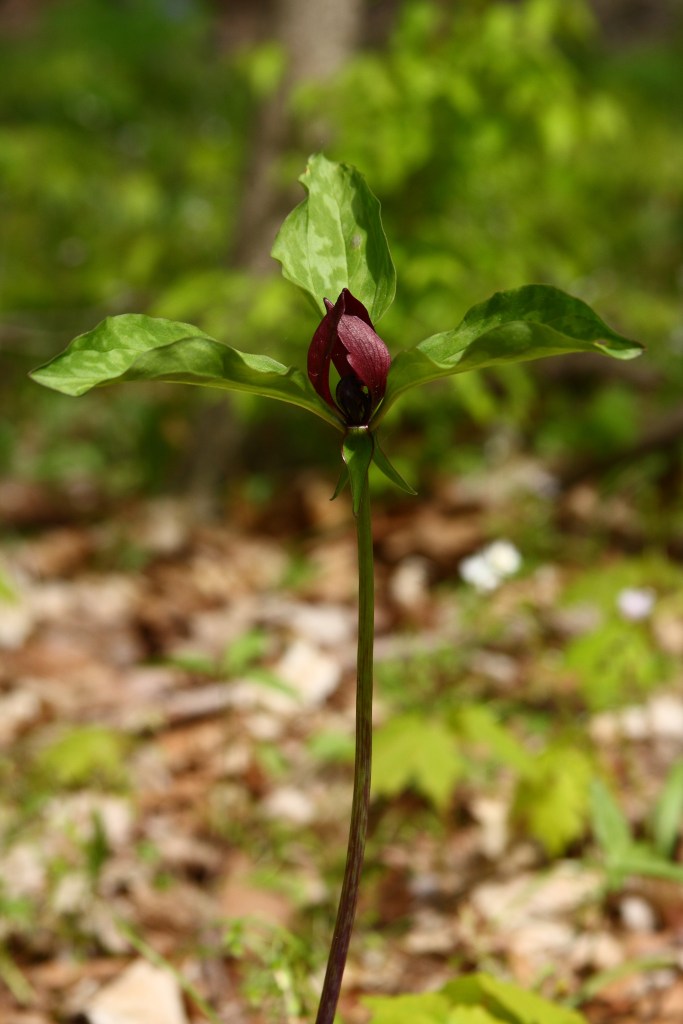
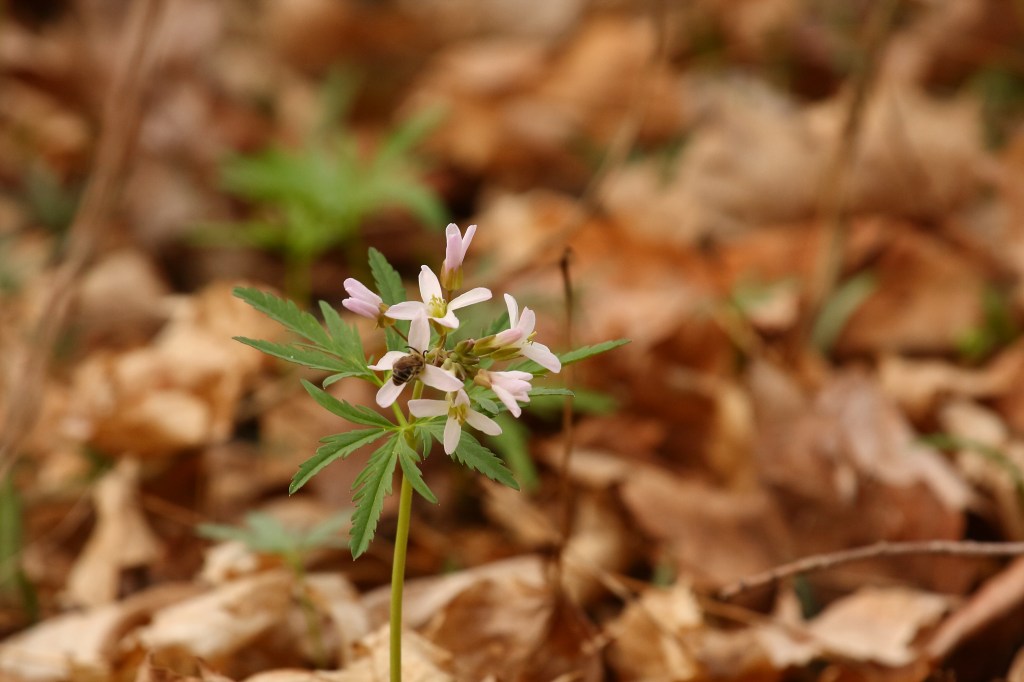
Winter is by no means the only time to visit Busey Woods. In the spring, late March through early May, you will be treated to a colorful show of ephemeral spring flowers (photos 11, 12). Ephemeral flowers are those that grow and bloom during just part of the year, generally spring. After they bloom, they die back and are no longer visible on the forest floor. This pattern of growth allows the plants to capture the spring sunlight before the trees above begin to leaf out and cast heavy shade on the forest floor. Dying back to their roots saves energy for the flowers that would otherwise struggle to survive in the shade.
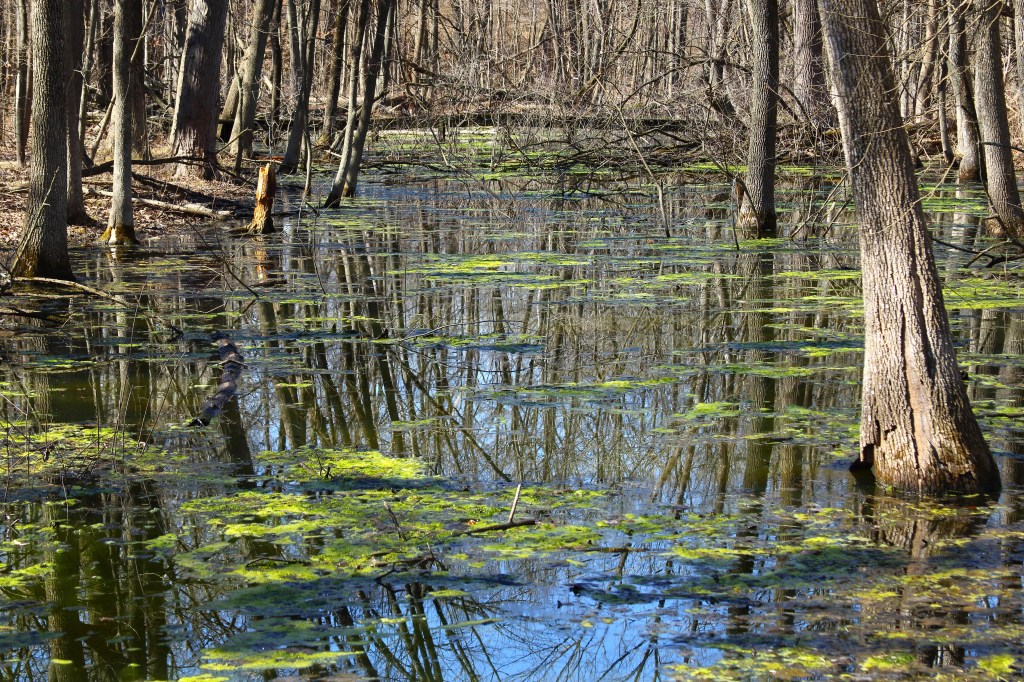
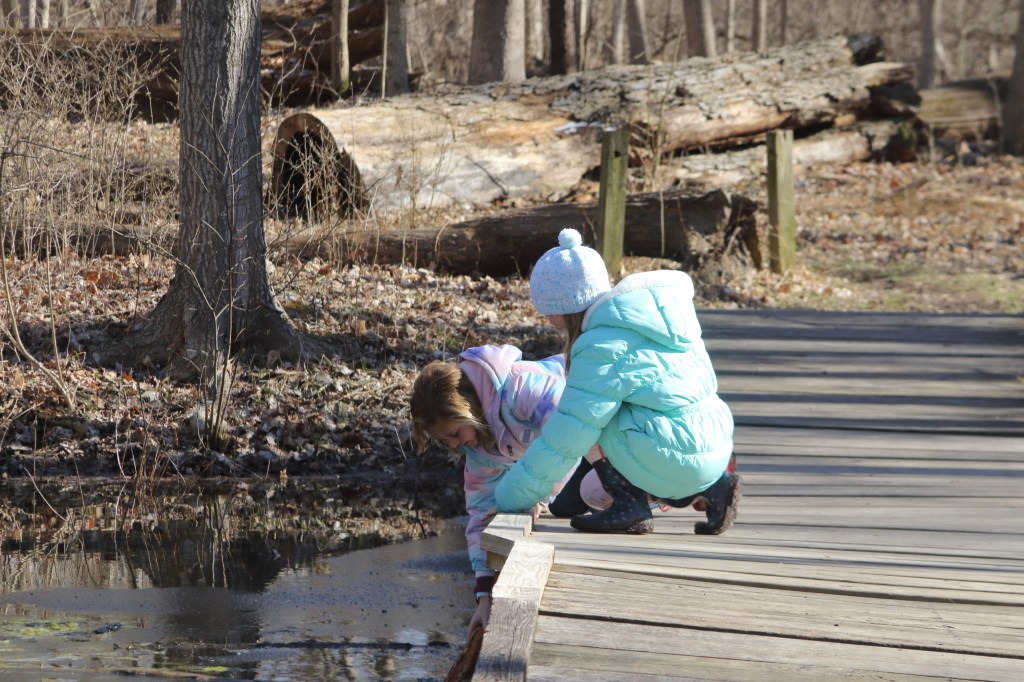
In addition to ephemeral spring flowers, Busey Woods is also the site of ephemeral ponds. As already described, when settlers first came to the area the Saline Branch took a meandering path through Busey Woods. After the Saline Branch was rerouted, the former streambed became just another low area. However, in the spring and at other wet times of the year, sections of these old meanders fill with water, forming small ponds (photo 13). The ponds are not permanent, though. During summers without much rain, these ephemeral ponds dry up. If you have young children, bring them to the woods in the spring. The ephemeral ponds are an inexhaustible source of activity and wonder for kids (photo 14).
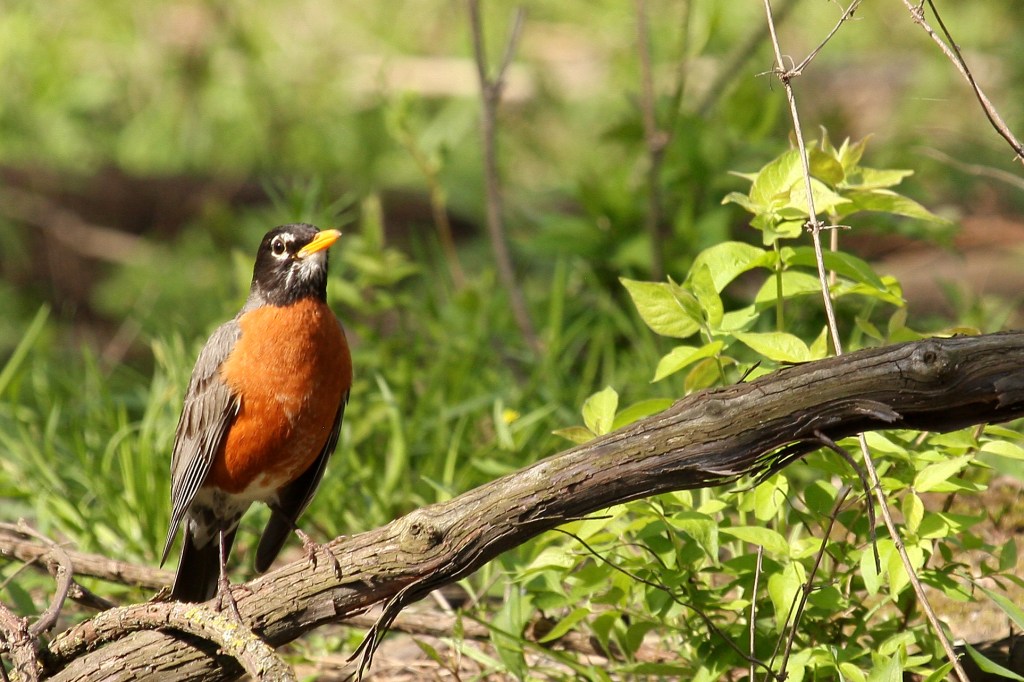
Spring brings another phenomenon to the woods – the annual spring migration of birds that spend their winters in tropical or subtropical parts of the Americas and their summers either here or farther north (photo 15). Even if you know little about birds or how to identify them, you can enjoy these birds with the help of local experts. Every spring during migration season, friendly experts from the Illinois Audubon Society lead free bird walks on Sundays from early March to the end of May. Participants simply show up at the Anita Purvis Nature Center by 7:30 a.m. and join the hike. Taking these hikes in Busey Woods or the nearby Crystal Lake Park is a great way to learn about birds and to meet other nature enthusiasts.
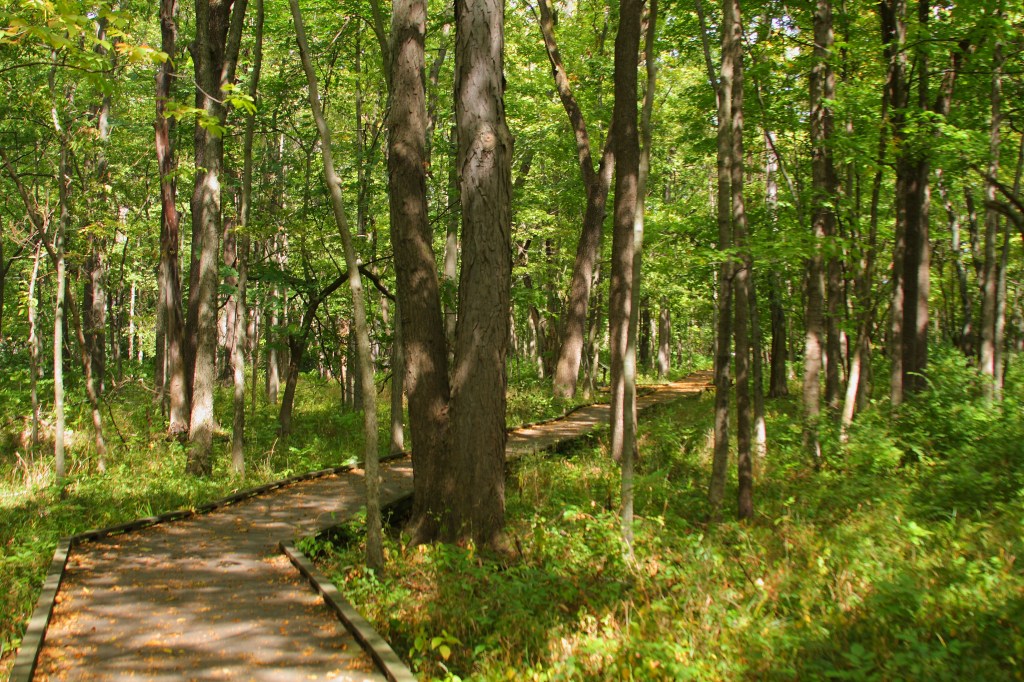
As spring morphs into summer, the leaves come out on the trees, transforming Busey Woods from an open, airy place to one filled with shadows and a bit of dappled sunlight (photo 16). On a hot summer day, I enjoy the relaxation to be had just strolling in the shade of the oaks and hickories of Busey Woods.
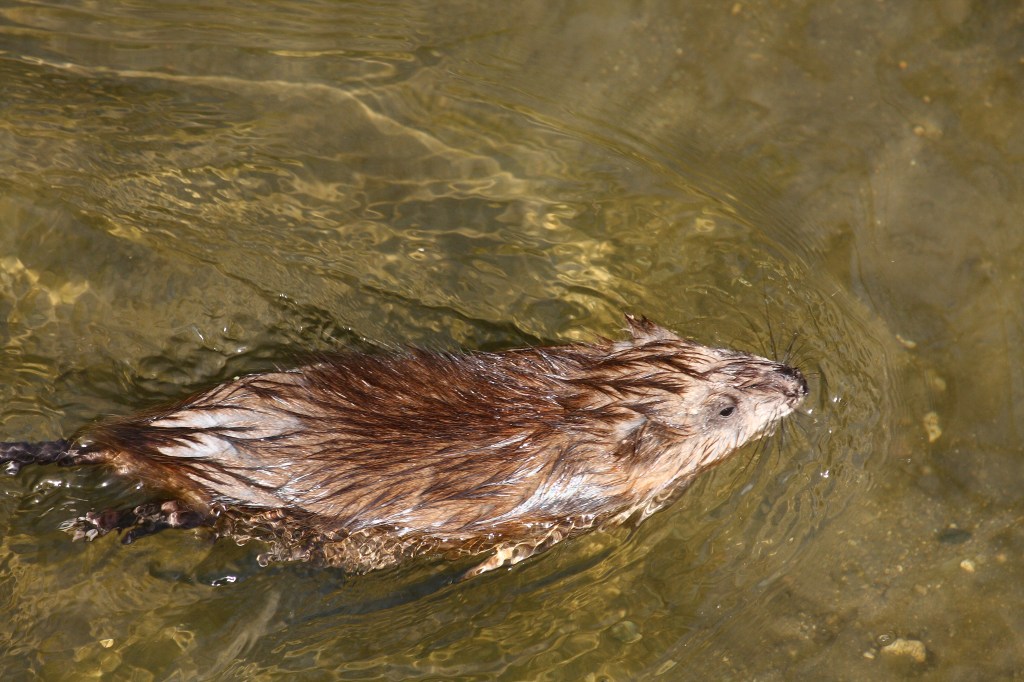
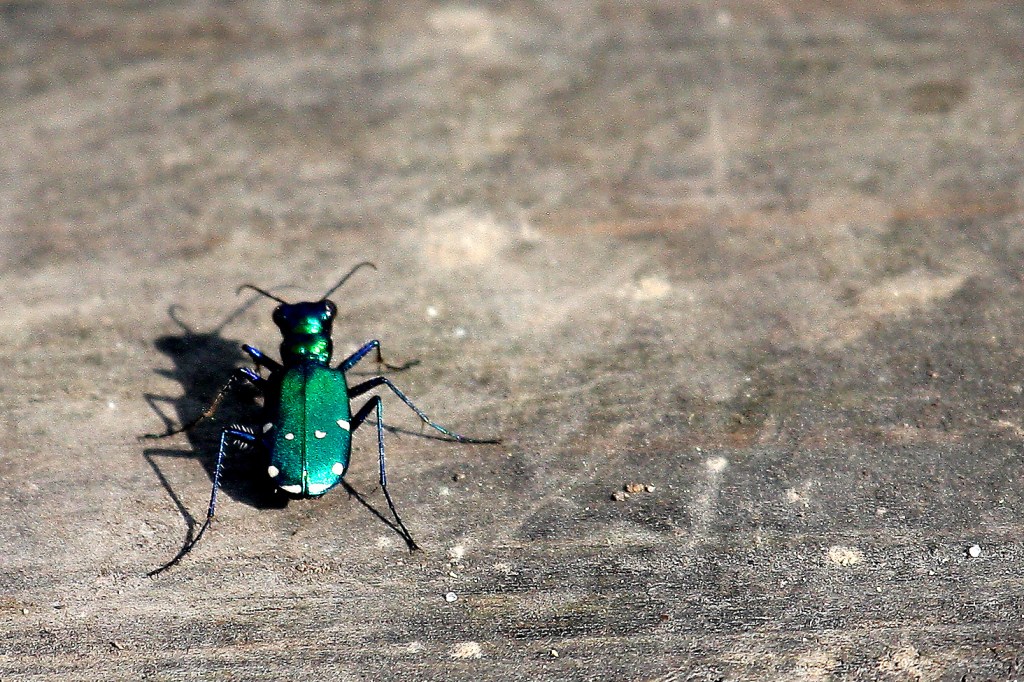
If you’re lucky, you could also see birds or other animals. I was fortunate one day to be looking down as I crossed the bridge over the Saline Branch into Busey Woods. There I saw an animal that lives on, or actually in, the banks of the stream – a muskrat (photo 17). Looking down might reveal other animals as well, particularly often-overlooked insects. On the boardwalk as well as on the trails, it’s not uncommon to see small, colorful beetles scurrying along (photo 18), six-spotted tiger beetles. They are harmless to humans and in fact run away if you approach them. They’re a bit unusual among insects in that their preferred escape method is running, not flying.
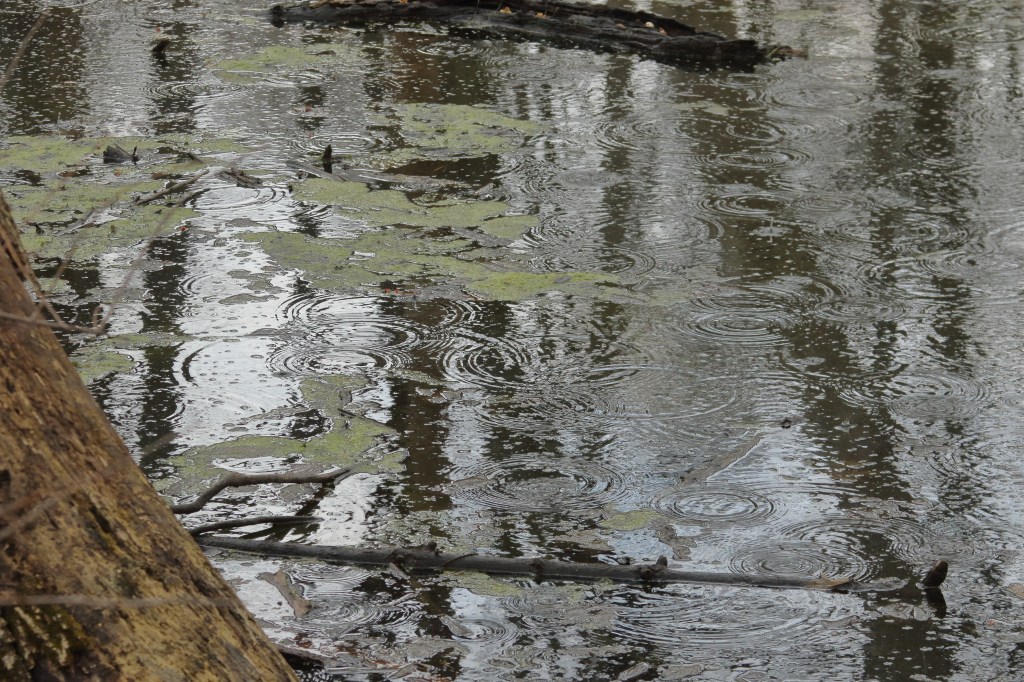
My description thus far has concentrated on what you can see in reasonably good weather. It should be pointed out, though, that relaxing sights and sounds can be experienced even if the weather is not so good. You may not think so, but the pitter-patter of rain and the gentle ripples it forms on a pond can be quite soothing (photo 19).
As summer turns to fall, don’t forget that migrating birds are once more traversing the area, this time travelling in the opposite direction. Just as they did during the spring migration, birding enthusiasts from the Illinois Audubon Society once again lead free birding walks through Busey Woods. These occur from September through October, meeting times being the same as for spring walks, 7:30 a.m. starting from the Anita Purvis Nature Center.
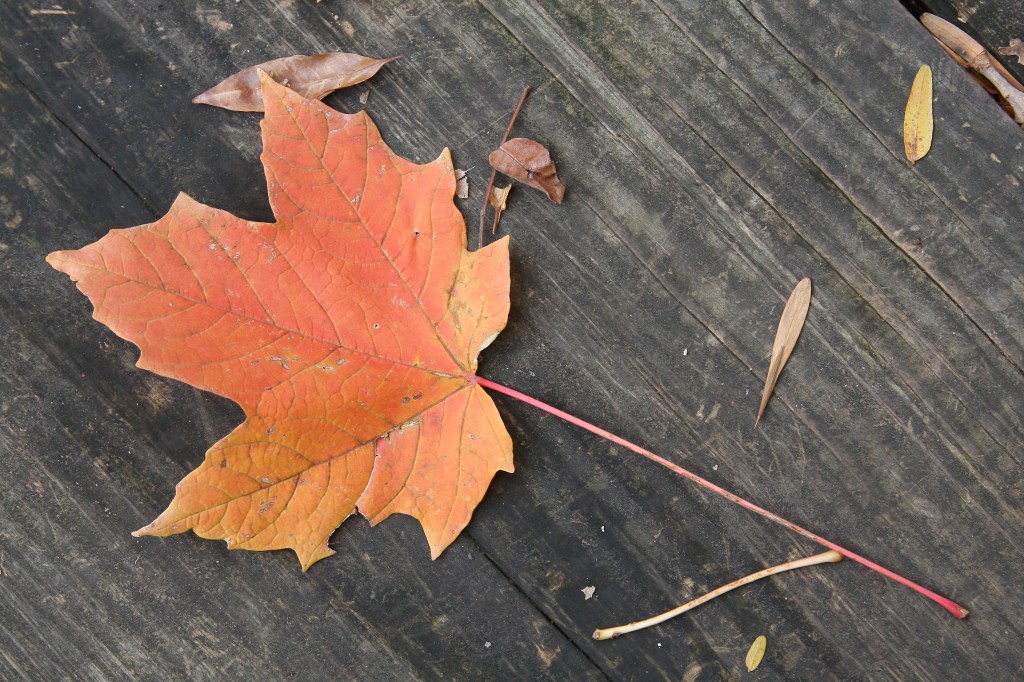
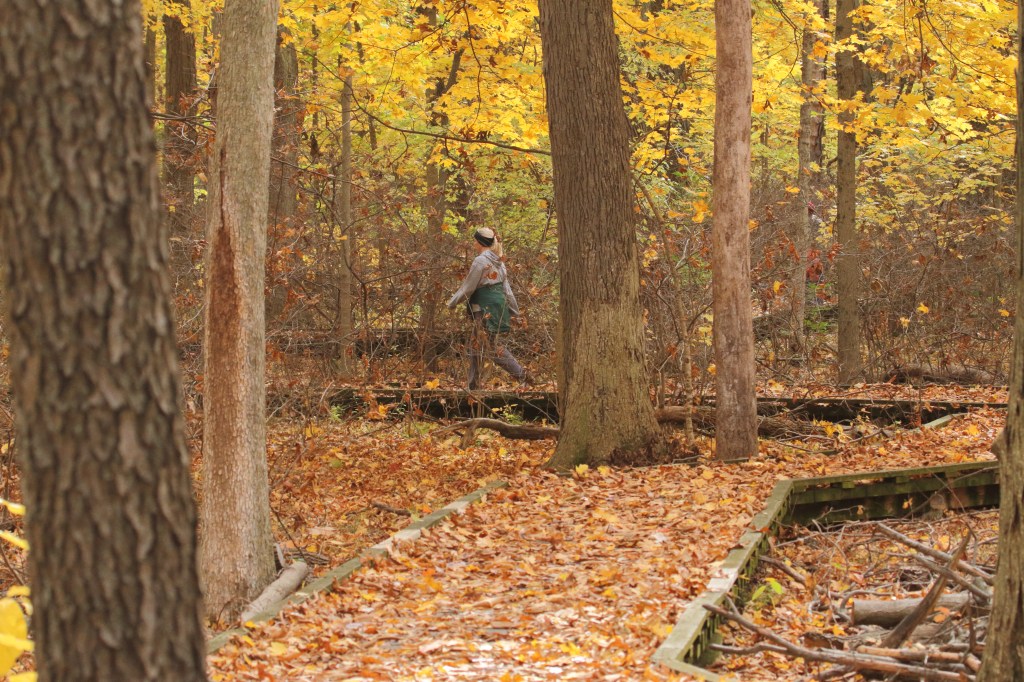
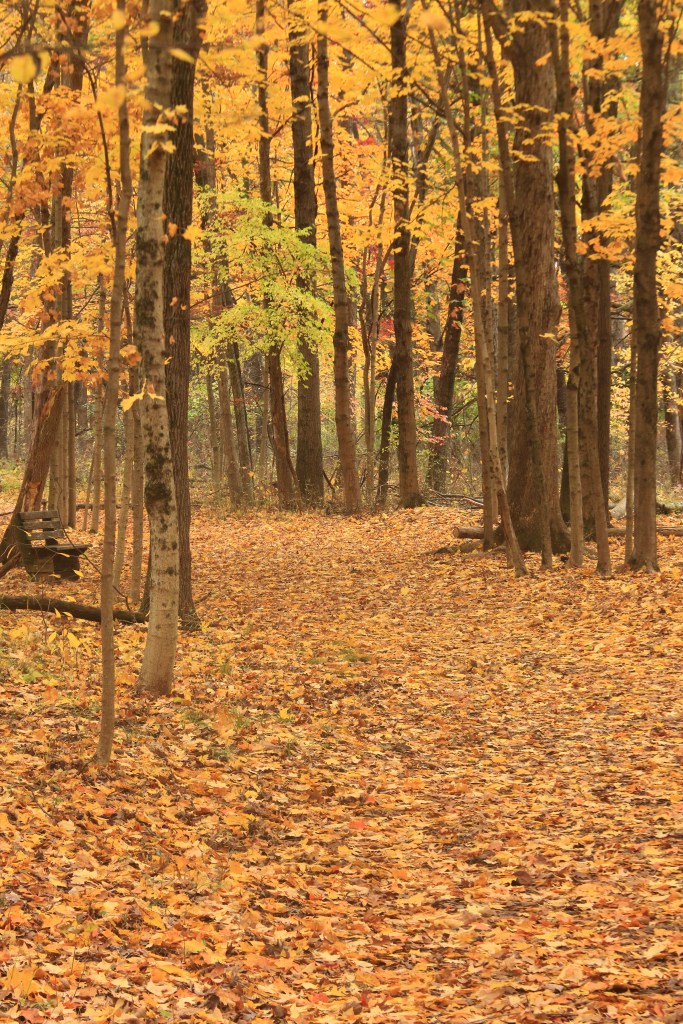
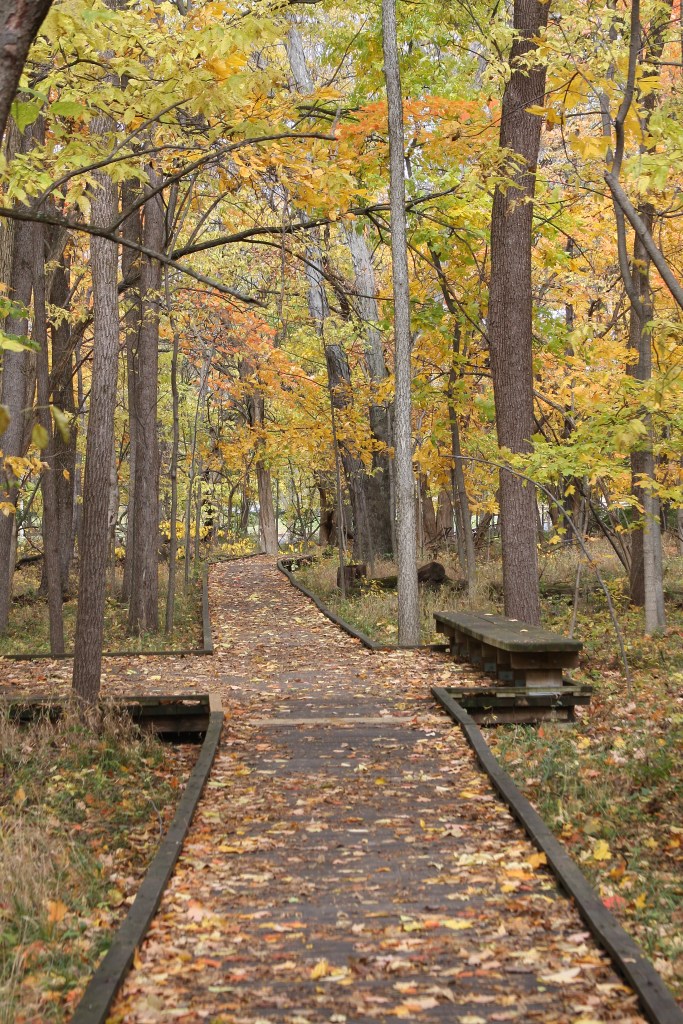
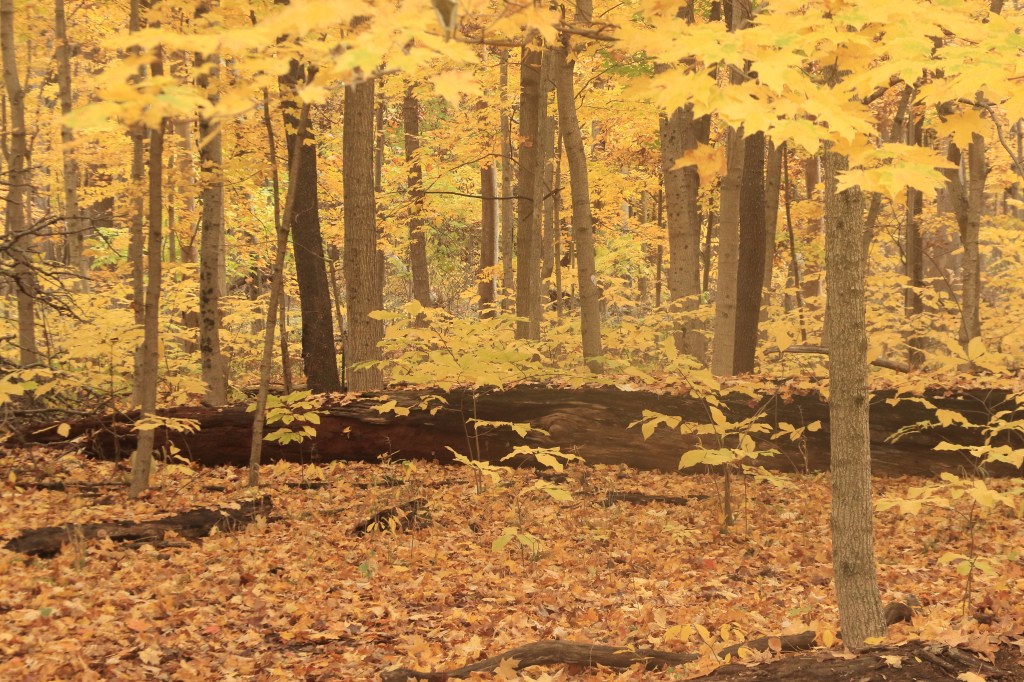
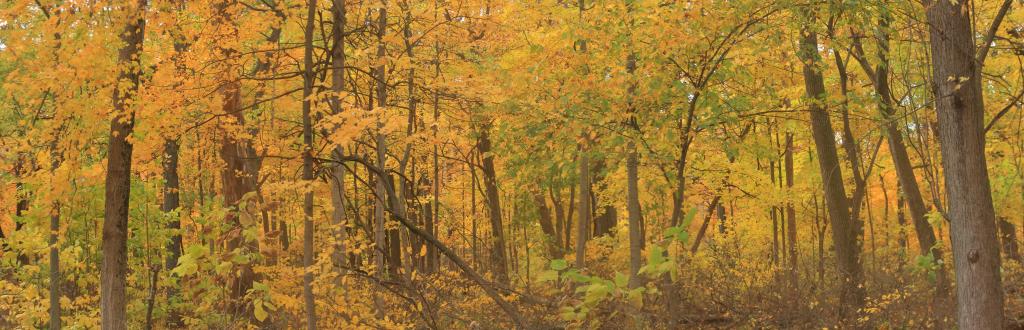
Fall is my favorite time of year. If you are in the woods from late September through October, the change of the seasons is quite obvious. First, individual leaves brighten up the boardwalk (photo 20). Then suddenly (it can happen in just a few days) the boardwalk (photo 21) and the trails (photo 22) are covered by a carpet of golden leaves. Even as an adult you might revel in the childlike joy of scuffling your feet through the leaves as you walk. Actually, though, the rest of the woods can be so spectacular that you may forget to look down. The trees are ablaze in a riot of yellow, orange, and red leaves, giving an otherworldly feel to the place (photo 23). Even a panorama of the woods at this time of year hardly does justice to the reality (photo 24).
The next time you feel you need rejuvenation from the stresses of your daily activities, take time to visit Busey Woods. A little bit of shinrin-yoku may be just what you need to restore your mental equilibrium.
Geo Info:
Busey Woods is located just west of the Anita Purvis Nature Center, north of the Family Aquatic Center and Crystal Lake Park. Access is off Broadway Street. For navigation, use the street address of 1505 N. Broadway, Urbana, IL 61801. There is ample parking.
About the Author:
Fred Delcomyn, a professor emeritus of the School of Integrative Biology at the University of Illinois at Urbana-Champaign, is the author with James Ellis of A Backyard Prairie as well as more than 100 popular and scientific articles. Since his retirement in 2008, he has written about and photographed nature around the world. He completed training as a Master Naturalist in 2017; his writing and photography are featured in various publications.
(Guest Editor: Yiwen Bi)

 Champaign Magazine
Leave a comment